




THE FACILITY FILE · VOLUME 1
A Leitner Warywoda Nursing Home Accountability Series
When the Records Don’t Lie
Inside The Paramount at Somers’ Decade of
Dangerous Understaffing and Regulatory Failures
By the Attorneys of Leitner Warywoda, PLLC
March 2026
ABOUT THIS SERIES
“The Facility File” examines the publicly available regulatory records of New York nursing homes — the inspection reports, staffing data, federal citations, and civil penalties that facilities are required to report but rarely publicize. Our goal: to give families the information they need before placing a loved one in a nursing home, and to hold accountable those facilities whose records reveal a pattern of harm.
When a family chooses a nursing home for a loved one, they are trusting that facility with one of the most vulnerable people in their lives. That trust should be earned — and it should be verifiable.
Every Medicare- and Medicaid-certified nursing home in the United States is subject to routine inspections, complaint investigations, and staffing audits conducted by federal and state regulators. The results are public. The deficiency citations are available. The staffing ratios are documented. The fines are on record.
Most families never see any of it.
At Leitner Warywoda, we do. We review these records as a matter of course when we investigate nursing home injury and wrongful death cases across New York. What we find — facility after facility — is that the public record frequently tells a very different story than the one the facility presents in its brochures and on its website.
This report examines one facility in detail: The Paramount at Somers Rehabilitation and Nursing Center, located in Somers, New York (Westchester County), and operated by Somers Operating LLC under the CareRite Centers management umbrella. We have reviewed its federal inspection reports, CMS staffing data, state enforcement records, and civil litigation filings.
“What we find — facility after facility — is that the public record frequently tells a very different story than the one the facility presents in its brochures.”
I. About The Paramount at Somers
The Paramount at Somers is a large skilled nursing facility at 189 Route 100 in Somers, New York. It holds 300 certified beds and operates at roughly 92% occupancy — meaning it is rarely less than almost full. It is dually certified for Medicare and Medicaid, requiring compliance with both federal nursing home regulations (42 CFR Part 483) and New York’s Public Health Law and Title 10 NYCRR Part 415.
The facility was formerly known as Somers Manor Rehabilitation and Nursing Center. In January 2018, ownership transferred to Somers Operating LLC, operating under the CareRite Centers management chain — a group of 34 nursing homes across New York, New Jersey, Florida, and Tennessee.
The facility’s CMS Certification Number is 335261. Its overall CMS star rating has declined from three stars to two out of five — below average. That headline number, however, understates the seriousness of what the underlying records show.
CATEGORY CMS RATING WHAT IT MEANS
Overall ★★☆☆☆
2 / 5 Below average — declined from 3 stars
Health Inspections ★★★☆☆
3 / 5 Average — but with serious citation history
Staffing ★☆☆☆☆
1 / 5 LOWEST POSSIBLE SCORE — chronically unsafe
Quality Measures ★★★★★
5 / 5 Highest — but based largely on self-reported data
Note: The 5-star quality measures score is based largely on self-reported facility data. The 1-star staffing score is based on independently verified CMS payroll data. The contrast between these two scores is itself significant.
II. The Staffing Crisis: Below Unsafe Levels Almost Every Day
CMS rates nursing homes in three categories: health inspections, staffing, and quality measures. The Paramount at Somers has achieved a five-star quality measures rating — the highest possible. Its staffing rating, however, is one star out of five — the lowest possible.
The payroll data, verified independently by CMS, tells a stark story.
A. CNA Staffing Below Unsafe Levels Every Year Since 2019
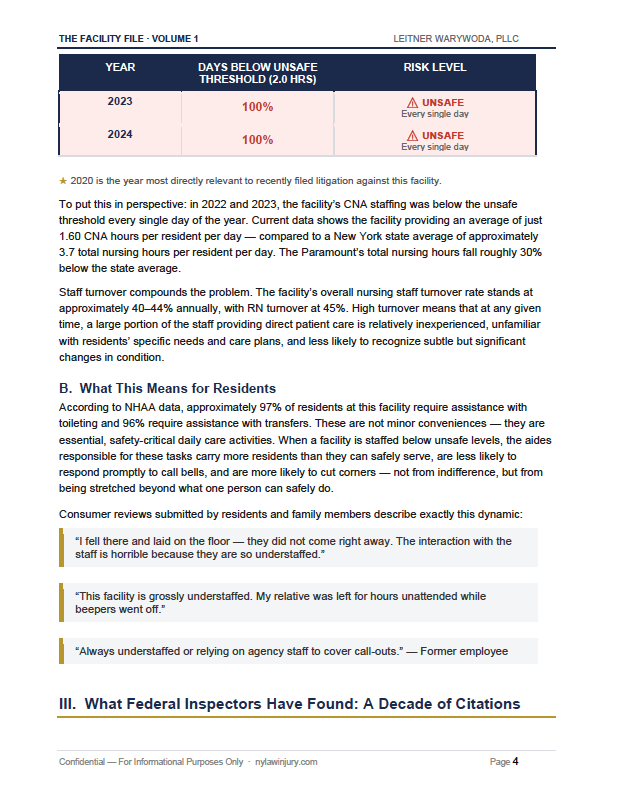
The Institute of Medicine has identified 2.0 certified nursing assistant (CNA) hours per resident per day as the threshold below which care becomes unsafe. The table below shows the percentage of days The Paramount at Somers fell below that threshold in each measured year:
YEAR DAYS BELOW UNSAFE THRESHOLD (2.0 HRS) RISK LEVEL
2019 96.4% ⚠ UNSAFE
2020 ★ 97.8% ⚠ UNSAFE
Year at issue in pending litigation
2021 94.0% ⚠ UNSAFE
2022 100% ⚠ UNSAFE
Every single day
2023 100% ⚠ UNSAFE
Every single day
2024 100% ⚠ UNSAFE
Every single day
★ 2020 is the year most directly relevant to recently filed litigation against this facility.
To put this in perspective: in 2022 and 2023, the facility’s CNA staffing was below the unsafe threshold every single day of the year. Current data shows the facility providing an average of just 1.60 CNA hours per resident per day — compared to a New York state average of approximately 3.7 total nursing hours per resident per day. The Paramount’s total nursing hours fall roughly 30% below the state average.
Staff turnover compounds the problem. The facility’s overall nursing staff turnover rate stands at approximately 40–44% annually, with RN turnover at 45%. High turnover means that at any given time, a large portion of the staff providing direct patient care is relatively inexperienced, unfamiliar with residents’ specific needs and care plans, and less likely to recognize subtle but significant changes in condition.
B. What This Means for Residents
According to NHAA data, approximately 97% of residents at this facility require assistance with toileting and 96% require assistance with transfers. These are not minor conveniences — they are essential, safety-critical daily care activities. When a facility is staffed below unsafe levels, the aides responsible for these tasks carry more residents than they can safely serve, are less likely to respond promptly to call bells, and are more likely to cut corners — not from indifference, but from being stretched beyond what one person can safely do.
Consumer reviews submitted by residents and family members describe exactly this dynamic:
“I fell there and laid on the floor — they did not come right away. The interaction with the staff is horrible because they are so understaffed.”
“This facility is grossly understaffed. My relative was left for hours unattended while beepers went off.”
“Always understaffed or relying on agency staff to cover call-outs.” — Former employee
III. What Federal Inspectors Have Found: A Decade of Citations
Every Medicare- and Medicaid-certified nursing home is inspected by state surveyors acting on behalf of CMS at least annually, with additional investigations conducted in response to complaints. When inspectors find violations, they issue formal deficiency citations. The citations at The Paramount at Somers reveal a recurring pattern of failures in exactly the areas that put residents at greatest risk.
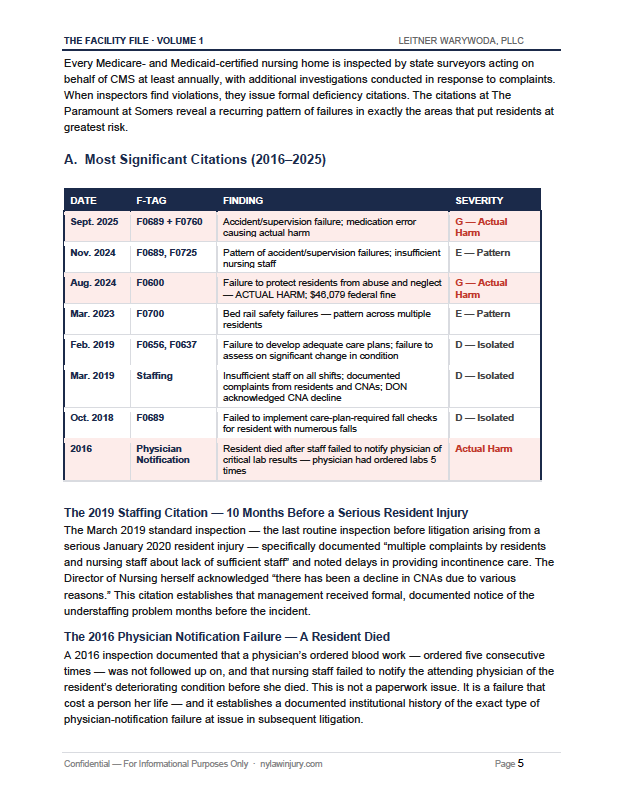
A. Most Significant Citations (2016–2025)
DATE F-TAG FINDING SEVERITY
Sept. 2025 F0689 + F0760 Accident/supervision failure; medication error causing actual harm G — Actual Harm
Nov. 2024 F0689, F0725 Pattern of accident/supervision failures; insufficient nursing staff E — Pattern
Aug. 2024 F0600 Failure to protect residents from abuse and neglect — ACTUAL HARM; $46,079 federal fine G — Actual Harm
Mar. 2023 F0700 Bed rail safety failures — pattern across multiple residents E — Pattern
Feb. 2019 F0656, F0637 Failure to develop adequate care plans; failure to assess on significant change in condition D — Isolated
Mar. 2019 Staffing Insufficient staff on all shifts; documented complaints from residents and CNAs; DON acknowledged CNA decline D — Isolated
Oct. 2018 F0689 Failed to implement care-plan-required fall checks for resident with numerous falls D — Isolated
2016 Physician Notification Resident died after staff failed to notify physician of critical lab results — physician had ordered labs 5 times Actual Harm
The 2019 Staffing Citation — 10 Months Before a Serious Resident Injury
The March 2019 standard inspection — the last routine inspection before litigation arising from a serious January 2020 resident injury — specifically documented “multiple complaints by residents and nursing staff about lack of sufficient staff” and noted delays in providing incontinence care. The Director of Nursing herself acknowledged “there has been a decline in CNAs due to various reasons.” This citation establishes that management received formal, documented notice of the understaffing problem months before the incident.
The 2016 Physician Notification Failure — A Resident Died
A 2016 inspection documented that a physician’s ordered blood work — ordered five consecutive times — was not followed up on, and that nursing staff failed to notify the attending physician of the resident’s deteriorating condition before she died. This is not a paperwork issue. It is a failure that cost a person her life — and it establishes a documented institutional history of the exact type of physician-notification failure at issue in subsequent litigation.
⚠ REGULATORY RECORD: 15 IMMEDIATE JEOPARDY FINDINGS ACROSS 13 YEARS
At the top of CMS’s deficiency severity scale sits “Immediate Jeopardy” — a finding that the facility’s noncompliance “has caused, or is likely to cause, serious injury, harm, impairment, or death to a resident.” The Paramount at Somers has been found at the Immediate Jeopardy level 15 times across surveys dating from November 2011 through August 2024 — averaging more than one per year. A $46,079 federal civil monetary penalty was imposed in August 2024 following a finding of actual harm to a resident.
IV. COVID-19: A Crisis the Record Suggests the Facility Was Ill-Equipped to Handle
In spring 2020, nursing homes across New York were devastated by the COVID-19 pandemic. The Paramount at Somers was no exception. News 12 Westchester reported in April 2020 that a family member alleged his 91-year-old grandmother displayed COVID-19 symptoms for approximately a week without being tested before she died. An anonymous nursing assistant stated: “There was a time when we didn’t have any tests and people weren’t being tested. It was actually quite sickening.”
New York State Department of Health records document approximately 51 COVID-related deaths associated with The Paramount at Somers during the pandemic period. A facility that entered the pandemic with chronic staffing below unsafe levels, 40%+ staff turnover, and a February 2019 infection control citation for staff failing to wash hands between resident contact was poorly positioned to protect residents when COVID-19 arrived.
V. What Families Should Know Before Choosing a Nursing Home
The information in this report is entirely public. Every family in New York can access it before placing a loved one in any nursing home.
A. Where to Look
• CMS Care Compare (medicare.gov/care-compare) — Star ratings, inspection reports, staffing data, and penalty history. Download the actual CMS-2567 Statements of Deficiency PDFs — not just the summary page.
• ProPublica Nursing Home Inspect (projects.propublica.org/nursing-homes) — Searchable deficiency citations with chain-level comparisons.
• NYS DOH Nursing Home Profiles (profiles.health.ny.gov/nursing_home) — New York’s own database of inspection results, complaint history, and enforcement actions, including stipulated fines.
• Nursing Home Abuse Advocate (nursinghomesabuseadvocate.com) — Tracks historical Immediate Jeopardy and Actual Harm findings that may fall outside CMS’s current rolling inspection window.
B. Warning Signs to Watch For
• Any staffing rating of 1 or 2 stars is a serious warning sign.
• Citations for F0689 (accidents/supervision), F0725 (staffing), F0600 (abuse/neglect), or F0656 (care planning) reflect failures in the most fundamental resident safety obligations.
• Immediate Jeopardy findings mean regulators determined residents were in danger of serious harm or death.
• Civil monetary penalties indicate a violation was serious enough to warrant federal financial punishment.
• High staff turnover — above 40–50% — means the people providing direct care are frequently unfamiliar with your loved one’s specific needs and documented care plan.
VI. When a Facility’s Failures Cause Harm: Your Legal Rights in New York
If your loved one has been injured in a New York nursing home — whether as a result of a fall, a pressure sore, medication error, delayed diagnosis, or any other form of neglect — you may have significant legal rights under New York law, including:
• Common law negligence — the right to compensation when a facility’s failure to exercise reasonable care causes injury.
• Public Health Law § 2801-d — New York’s nursing home residents’ rights statute, which allows residents and their families to bring claims for deprivation of rights or benefits, with enhanced remedies including attorney’s fees.
• Wrongful death claims under the Estates, Powers and Trusts Law (EPTL) — when a facility’s negligence contributes to a resident’s death.
New York’s statute of limitations for nursing home negligence claims is generally 2.5 years from the date of injury or discovery for medical malpractice-based claims, and 3 years for negligence claims, though the applicable period depends on how the claims are framed. Families should consult with an experienced attorney promptly — waiting can mean losing the right to bring a claim entirely.
The regulatory record discussed in this report — citations, staffing data, penalty history — is the kind of evidence that experienced nursing home attorneys use to demonstrate that a facility knew about its deficiencies, failed to correct them, and allowed those deficiencies to harm residents.
Has Your Loved One Been Harmed in a New York Nursing Home?
Leitner Warywoda, PLLC has recovered more than $250 million for injured New Yorkers and their families, including landmark results in nursing home negligence and wrongful death cases. Our attorneys know how to read regulatory records, obtain and analyze EMR audit trails, retain the right experts, and take cases to trial when justice requires it.
If your family has been affected by nursing home neglect or abuse — in Westchester County, New York City, Long Island, or anywhere in New York State — contact us for a free, confidential consultation. No fee unless we recover for you.
Call (212) 671-1110 · nylawinjury.com · Free Consultation
DISCLAIMER
The information in this report is drawn entirely from publicly available federal and state regulatory records, CMS databases, court filings, and news reporting. It is provided for general informational and educational purposes only and does not constitute legal advice. Prior results do not guarantee a similar outcome. If you have questions about a specific situation, please contact our office directly.
NEXT IN THE SERIES: Our next installment will examine another New York nursing home with documented patterns of harm — and explain what families can do when they suspect neglect is happening right now.