Resident Rights Under NY Public Health Law & Federal Regulations
Know your rights. Learn how NY Public Health Law protects nursing home residents across NYC & Long Island. Speak with a New York nursing home abuse lawyer today.
- Governing law
- PHL § 2801-d · 10 NYCRR Part 415
- Where we practice
- NYC · Long Island · Statewide
- Fee
- No fee unless we recover
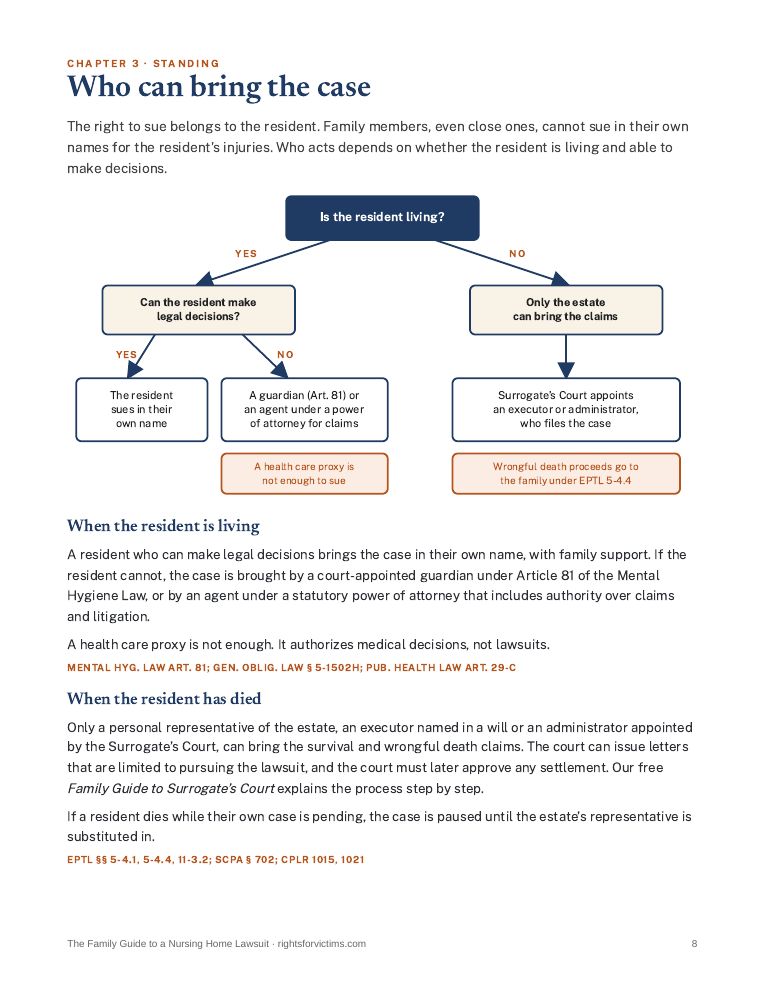
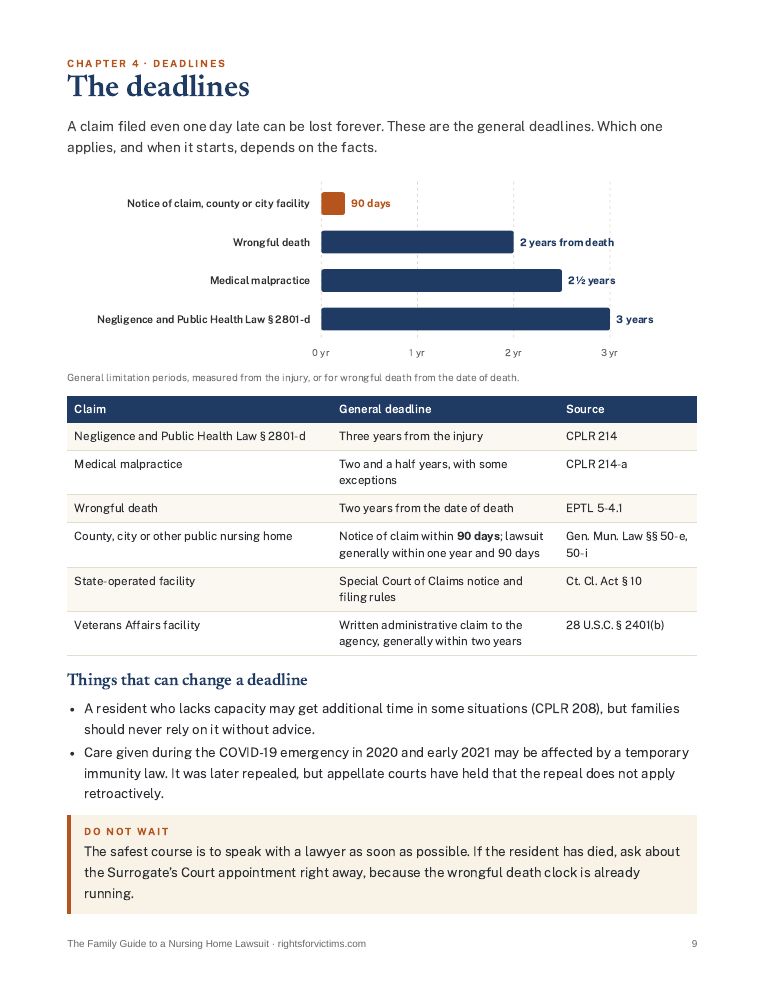
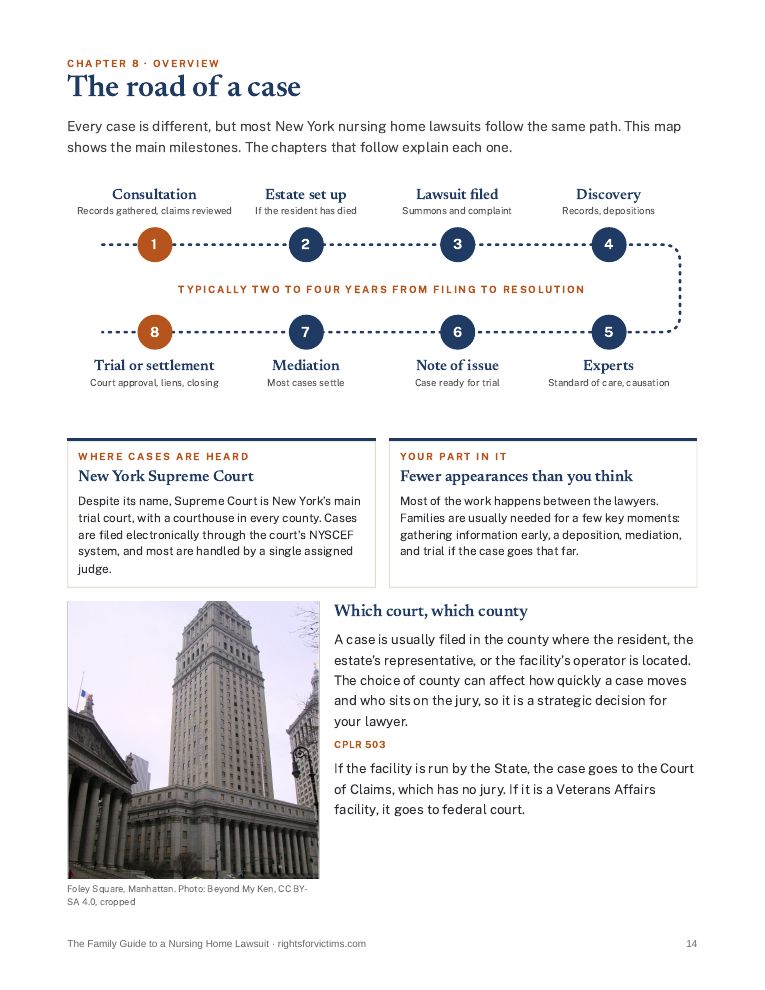
The Family Guide to a Nursing Home Lawsuit
How a case against a New York nursing home works, from the first phone call to the final check: the claims the law allows, who can bring them, the deadlines, the court process, settlement and liens, and what your family can expect. Illustrated, with checklists and a glossary.
- The claims New York allows, and who has the right to bring them
- The deadlines, including the 90-day rule for public facilities
- Arbitration clauses and preserving the evidence
- The lawsuit step by step, from filing to trial
- Settlement, court approval, and Medicare and Medicaid liens
PDF · 3.4 MB · No sign-up · Prints on any home printer · Also available from the New York Nursing Home Resource Center
Every New York Nursing Home Resident Has Legal Protections
Residents of nursing homes in New York City and Long Island are not powerless—they are protected by strong federal and state laws designed to ensure their safety, dignity, and well-being. When these rights are violated, families have the ability to demand accountability. At Leitner Warywoda, PLLC, we help families understand these legal protections and enforce them through aggressive legal action when abuse or neglect occurs.
Key Legal Protections Under Public Health Law §2801-d
New York’s Public Health Law §2801-d allows residents to sue for violations of their rights, including cases involving abuse, neglect, or substandard care. Unlike standard negligence claims, this law doesn’t require proof of physical injury—just proof that the resident’s rights were violated. These rights include proper nutrition, hygiene, freedom from restraints, privacy, and the right to be treated with respect. If a facility fails to meet these standards, legal action can follow—and damages can include compensation, attorneys’ fees, and punitive penalties.
Federal Regulations Support Dignity and Quality of Life
On the federal level, 42 CFR Part 483 sets nationwide requirements for nursing homes that receive Medicare or Medicaid funding. These include detailed rules on staffing levels, medical record access, care planning, infection prevention, and resident autonomy. If a nursing home violates these regulations, it can face state and federal sanctions—and lawsuits from harmed families. Our legal team uses these regulations as a framework to investigate and prove misconduct in both civil litigation and administrative hearings.
How Our Lawyers Help Families Assert Their Loved One’s Rights
Unfortunately, many families don’t realize these laws exist—until it’s too late. At Leitner Warywoda, we help clients obtain medical records, file complaints with the New York State Department of Health, and build strong cases rooted in statutory violations. Whether the harm involves bedsores, medication errors, or emotional abuse, we use the law to demand answers and secure justice for our clients. If your loved one’s rights have been violated, don’t wait to act.
Protect Your Family—Call a Nursing Home Abuse Lawyer in NY
Understanding your rights is the first step toward protecting your loved one. If you suspect a nursing home in NYC or Long Island has violated state or federal regulations, contact Leitner Warywoda for a free consultation. We’ll review your case, explain your options, and work to hold negligent providers accountable. You don’t pay unless we recover compensation for your family.
Related topics.
- Falls, Fractures & Brain InjuriesFalls and head injuries in nursing homes can signal serious neglect. Learn how a New York nursing home abuse lawyer can help. Serving NYC & Long Island families.Read more
- Malnutrition & DehydrationMalnutrition and dehydration are signs of nursing home neglect. A New York nursing home abuse lawyer can help you fight for justice. Serving NYC & Long Island families.Read more
- Medication Errors & OvermedicationOvermedication and drug errors in NYC nursing homes can lead to severe harm. Learn your rights from a New York nursing home abuse lawyer serving all boroughs & Long Island.Read more
- Physical & Sexual AbuseSuspect nursing home abuse in NYC or Long Island? Our New York nursing home abuse lawyers fight for victims of physical and sexual assault in elder care facilities.Read more
- Pressure Ulcers (Bed Sores)Bedsores are a sign of neglect. Learn how a New York nursing home abuse lawyer can help your family pursue justice for pressure ulcers and infections across NYC & Long Island.Read more
- Signs of AbuseDetect the signs of nursing home abuse and protect your loved ones in NYC. Understand signs of nursing home abuse today. Contact us!Read more
- Wrongful DeathLost a loved one due to nursing home neglect or abuse? Our New York nursing home abuse lawyers help NYC and Long Island families seek justice for wrongful death.Read more
From the first call to a resolution.
- 1
A real conversation, free
You tell us what happened. We tell you honestly whether it looks like a case, what the deadlines are, and what we would need to see.
- 2
We investigate before we file
Records, scene evidence, witnesses, and review by qualified experts. Most of what wins a case is gathered before a complaint is ever served.
- 3
Litigation, built for trial
Depositions, motions and expert disclosure, prepared as though the case will be tried, because defendants offer their best number to firms that are ready to try it.
- 4
Resolution, your decision
Settle or try it: that choice is yours, made with a clear picture of the offer, the risk and the timeline.
Recent nursing home abuse & neglect recoveries.
Extensive pressure injuries to a nursing home resident's lower extremity, Oneida County.
Fall with a dislodged catheter resulting in death, Bronx County.
Nursing home neglect involving a failure to diagnose.
Nursing home neglect, Suffolk County.
Fall resulting in a subdural hematoma, Suffolk County.
Wrongful death of a nursing home resident.
Prior results do not guarantee a similar outcome.
Frequently asked questions.
What rights do nursing home residents have under New York Public Health Law § 2801-d?
Section 2801-d lets a resident sue a nursing home that deprives them of any right or benefit created by contract, state or federal law, or regulation. That includes rights under 10 NYCRR Part 415 and 42 C.F.R. Part 483, such as adequate care, dignity, freedom from abuse and freedom from unnecessary restraints. The facility can defend by showing it exercised all care reasonably necessary to prevent the deprivation.
Can a nursing home be ordered to pay punitive damages in New York?
Possibly. Under Public Health Law § 2801-d, a court may award punitive damages when the deprivation of a resident's rights was willful or in reckless disregard of the resident's rights. Punitive damages are meant to punish serious misconduct, not just compensate the resident, and they are not available in every case. Whether the facts support them depends on what the facility knew and how it responded.
Is a Public Health Law § 2801-d claim different from a negligence lawsuit?
Yes. A negligence claim focuses on whether the facility failed to act with reasonable care and caused injury. A § 2801-d claim focuses on whether the facility violated a specific right protected by statute or regulation. The statute states its remedies are in addition to other remedies, so both claims are commonly brought together. Each claim generally carries a three-year deadline under CPLR 214, though exceptions can apply.
Can a nursing home evict or discharge my loved one without notice?
Generally, no. Federal regulations at 42 C.F.R. § 483.15 limit involuntary transfers and discharges to specific reasons, such as the resident's needs not being met or nonpayment, and require written notice and appeal rights. In most cases the facility must give at least 30 days' notice. A resident may appeal through the New York State Department of Health. An unlawful discharge can also support a resident rights claim.
Does signing a nursing home arbitration agreement waive my loved one's right to sue?
Not necessarily. Federal rules at 42 C.F.R. § 483.70 prohibit nursing homes from requiring residents to sign arbitration agreements as a condition of admission and give residents the right to rescind within 30 days. Whether an agreement already signed is enforceable depends on how it was presented, who signed it and their authority to do so. Bring any admission paperwork you have so it can be reviewed.