North Hempstead Nursing Home Abuse Lawyers
Bedsores, falls, infections, malnutrition and abuse in a North Hempstead nursing home. We represent residents and families throughout the Town of North Hempstead from our office in Huntington.
- Office
- 44 Elm Street, Huntington
- Homes in the town
- 5 certified nursing homes
- Fee
- No fee unless we recover
Source: CMS Care Compare provider data, October 2026 release.
Nursing homes in the Town of North Hempstead
Five Medicare- and Medicaid-certified nursing homes operate in the Town of North Hempstead, with 1,116 certified beds: Highfield Gardens Care Center of Great Neck and The Grand Rehabilitation and Nursing at Great Neck in Great Neck, Northwell Health Stern Family Center for Rehabilitation in Manhasset, Sands Point Center for Rehab & Nursing in Port Washington and Sunharbor Manor in Roslyn Heights.
One holds a five-star overall rating. None was fined by CMS in roughly the last three years. The average long-stay pressure-ulcer rate across the five homes reporting one is 5.8 percent, against a New York average of 6.5 percent and a national average of 4.5 percent.
Town of North Hempstead nursing homes at a glance
| Facility | Address | Beds | Overall | Inspections | Staffing | Pressure injuries | Fines | Flags |
|---|---|---|---|---|---|---|---|---|
| Highfield Gardens Care Center of Great Neck | 199 Community DriveGreat Neck | 200 | ★★★★★ | 3 | 3 | 2.9% | — | |
| Northwell Health Stern Family Center for Rehabilitation | 300 Community DriveManhasset | 256 | ★★★★★ | 3 | 5 | 10.8% | — | |
| Sands Point Center for Rehab & Nursing | 1440 Port Washington BlvdPort Washington | 180 | ★★★★★ | 3 | 3 | 5.3% | — | |
| Sunharbor Manor | 255 Warner AvenueRoslyn Heights | 266 | ★★★★★ | 2 | 3 | 7.8% | — | |
| The Grand Rehabilitation and Nursing at Great Neck | 15 ST Pauls PlaceGreat Neck | 214 | ★★★★★ | 4 | 2 | 2.2% | — |
Source: Centers for Medicare & Medicaid Services, Care Compare provider data, October 2026 release. Star ratings run 1 (much below average) to 5 (much above average). Pressure-injury rate is the CMS long-stay measure: the share of long-stay residents with a pressure ulcer. Fines are federal civil money penalties over roughly the last three years. Ratings change monthly; a rating or citation does not by itself mean that any resident has a legal claim. State averages for comparison: New York 6.5%, national 4.5%.
What recent inspections found
Federal inspection reports are public. The most serious findings at homes in the town since 2023 — citations where inspectors found actual harm to a resident or immediate jeopardy to resident health or safety — include:
- Northwell Health Stern Family Center for Rehabilitation: in August 2026, an actual-harm citation (G) for pressure-ulcer prevention and treatment (F686).
A citation does not mean that your family member was harmed, and a clean record does not mean that they were not. What matters is the chart: the care plan, the turning and repositioning records, the skin assessments, the staffing for the shifts in question and what the home told you.
Bedsores and pressure injuries
A pressure injury that reaches Stage 3 or 4 often means the resident was left in one position too long, was not kept clean and dry, or was not eating and drinking enough, and that no one acted when the skin first changed. Federal rules require a home to prevent pressure ulcers unless they are clinically unavoidable and to treat them when they occur (42 C.F.R. § 483.25(b)). New York’s Public Health Law § 2801-d gives residents a direct right to sue when a home violates those rights.
Our free Family Guide to Bedsores explains each stage, how wounds are treated and what the home must document.
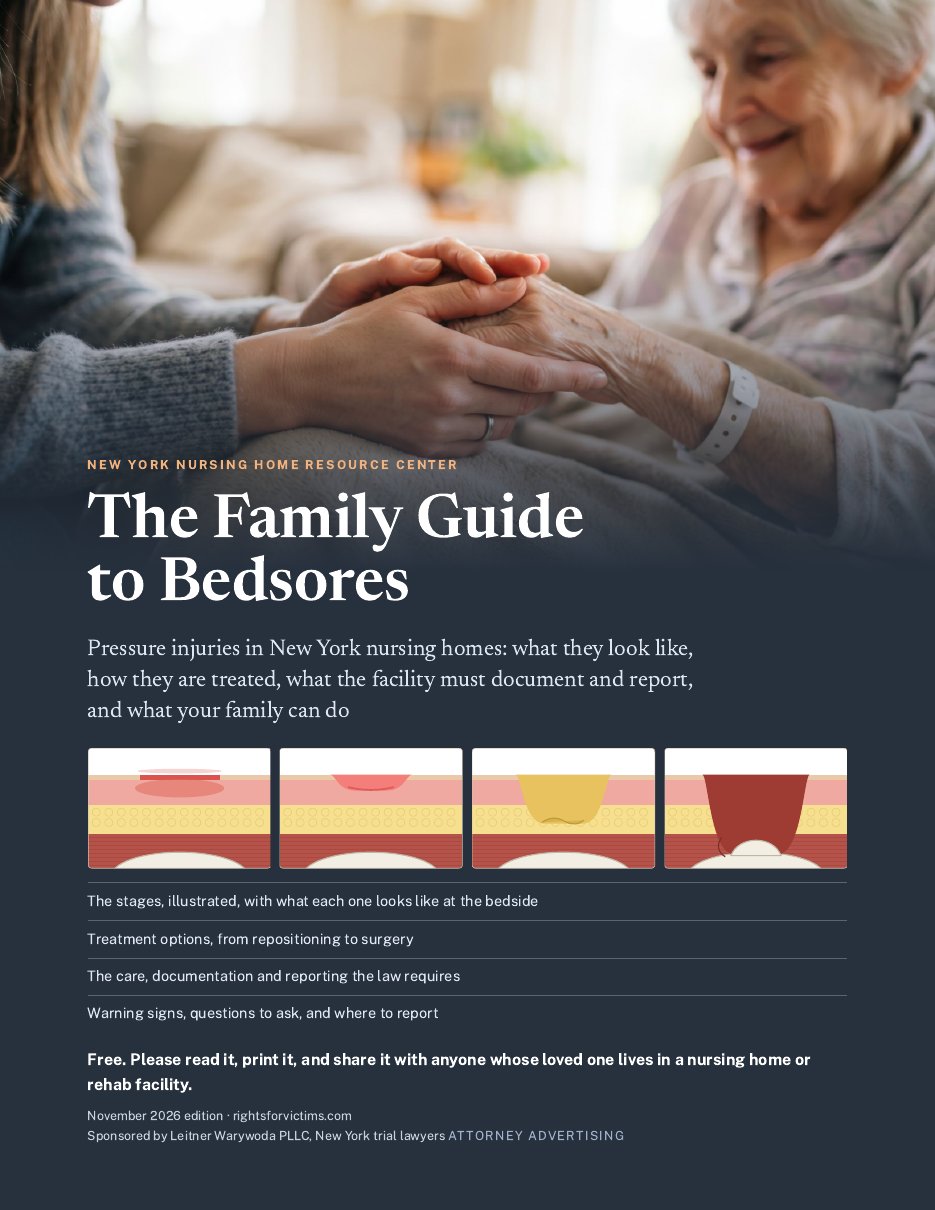
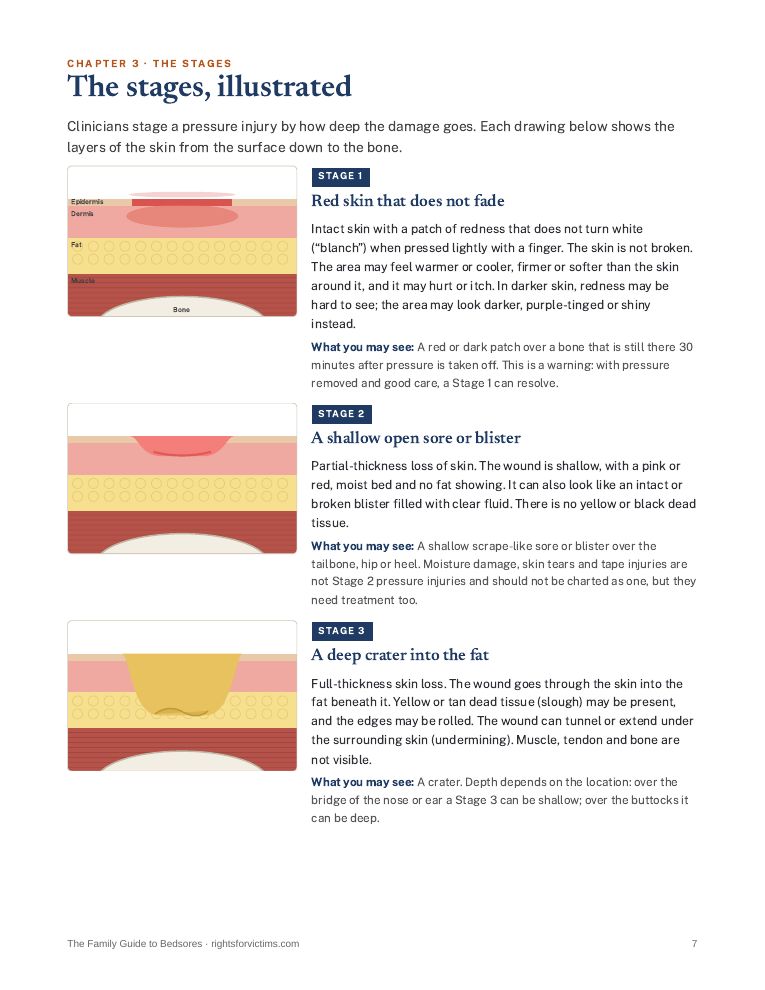
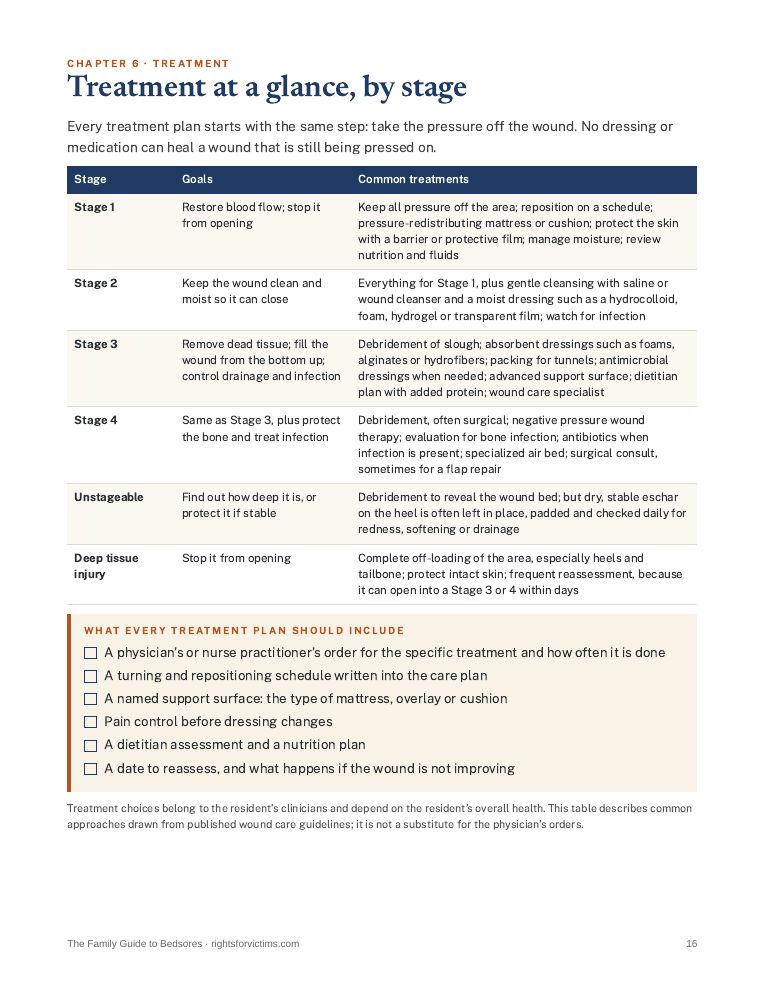
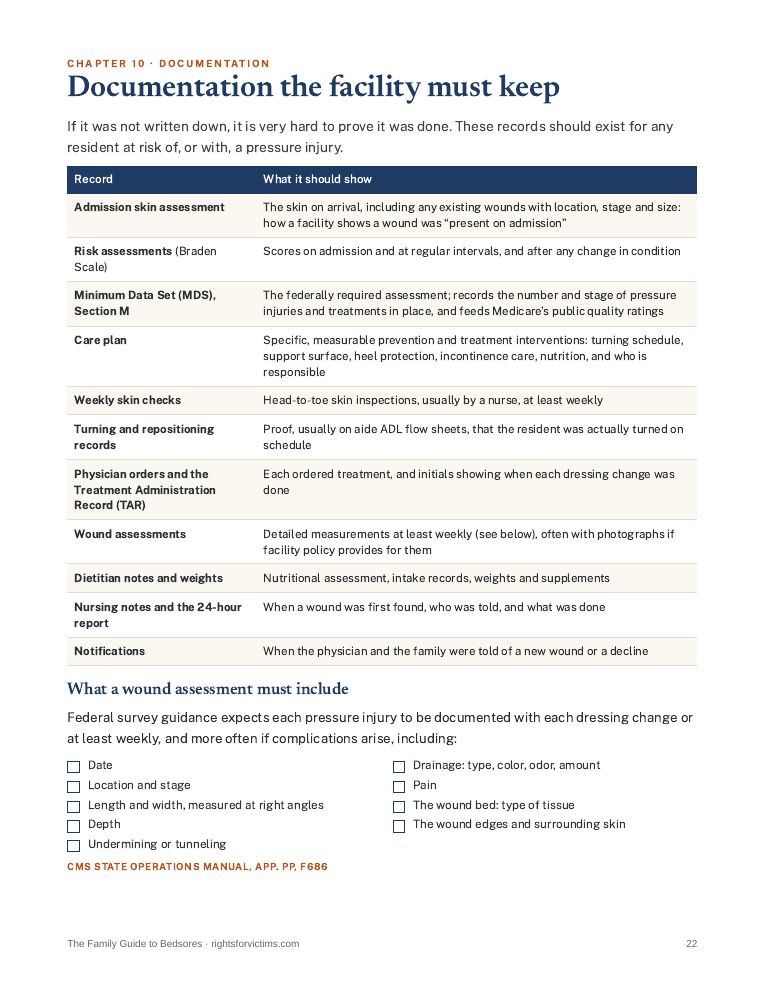
The Family Guide to Bedsores
What pressure injuries look like at every stage, how they are treated, what a New York nursing home must document and report, and what your family can do. Illustrated, with photographs, a printable visit log and a glossary.
- Every stage illustrated, from red skin to exposed bone
- Treatment options, from repositioning to surgery
- The documentation and reporting the law requires
- Warning signs, questions to ask and how to get the records
- Where to report, and the deadlines that protect your rights
PDF · 2 MB · No sign-up · Prints on any home printer · Also available from the New York Nursing Home Resource Center
North Hempstead cases: court, deadlines and reporting
Cases from the Town of North Hempstead are filed in Supreme Court, Nassau County, 100 Supreme Court Drive, Mineola. When a resident has died, the estate is opened in Nassau County Surrogate’s Court, 262 Old Country Road, Mineola; only the appointed administrator or executor can bring the wrongful death and survival claims, and we handle the limited letters of administration as part of the case.
Our main office is at 44 Elm Street in Huntington. We meet families at home, at the bedside or at the office.
- Public Health Law § 2801-d and negligence claims: generally three years from the injury (CPLR 214).
- Claims framed as medical malpractice: generally two years and six months (CPLR 214-a).
- Wrongful death: two years from the date of death (EPTL 5-4.1).
To report a problem: call 911 in an emergency; file a complaint with the New York State Department of Health, Centralized Complaint Intake, 1-888-201-4563; and contact the New York State Long Term Care Ombudsman Program (ltcombudsman.ny.gov).
Nearby areas we serve
Serving the Town of North Hempstead and its communities
Albertson · Carle Place · Great Neck · Herricks · Manhasset · Mineola · New Hyde Park · Port Washington · Roslyn · Westbury · Williston Park
Questions families ask
My parent is in a North Hempstead nursing home and has a bedsore. What should I do first?
Photograph the wound if you can do so respectfully, write down the date and what staff told you, and ask the home in writing for the care plan and the wound records. Then call us. If the wound is getting worse, ask for the physician and wound team the same day.
Can we bring a claim while our family member still lives there?
Yes. Retaliation against a resident for a complaint or lawsuit is prohibited, and many families bring claims while their parent remains in the home, or after moving them.
How long do we have?
Generally three years for Public Health Law § 2801-d and negligence claims, two and a half years for medical malpractice claims and two years for wrongful death. Public facilities can require a notice of claim within 90 days. The facts can change these periods, so call early.
What does it cost?
Nothing up front. We work on a contingency fee, which means no fee unless we recover.
Attorney Advertising. This page provides general information, not legal advice for any specific situation. Facility and crash data are reproduced from public CMS and New York State sources as of the dates shown and are not a statement by the firm about any facility’s care of any particular resident. Prior results do not guarantee a similar outcome.