Flushing Nursing Home Abuse Lawyers
Bedsores, falls, infections, malnutrition and abuse in a nursing home in Flushing and Northeast Queens. We represent residents and families from our New York City office at 14 Penn Plaza.
- Office
- 14 Penn Plaza, Manhattan
- Homes in the area
- 18 certified nursing homes
- Fee
- No fee unless we recover
Source: CMS Care Compare provider data, October 2026 release.
Nursing homes in Flushing and Northeast Queens
Eighteen Medicare- and Medicaid-certified nursing homes operate in Flushing and Northeast Queens, with 4,202 certified beds.
Five hold a five-star overall rating. Four were fined by CMS in roughly the last three years, for a combined $153,664. The average long-stay pressure-ulcer rate across the eighteen homes reporting one is 6.0 percent, against a New York average of 6.5 percent and a national average of 4.5 percent.
Flushing and Northeast Queens nursing homes at a glance
| Facility | Address | Beds | Overall | Inspections | Staffing | Pressure injuries | Fines | Flags |
|---|---|---|---|---|---|---|---|---|
| Bridge View Nursing Home | 143-10 20th AvenueWhitestone | 200 | ★★★★★ | 4 | 2 | 5.0% | — | |
| Cliffside Rehab & Residential Health Care Center | 119-19 Graham CourtFlushing | 218 | ★★★★★ | 4 | 2 | 12.7% | — | |
| Cypress Garden Center for Nursing and Rehabilitation | 139-66 35th AvenueFlushing | 278 | ★★★★★ | 4 | 2 | 4.5% | — | |
| Franklin Center for Rehabilitation and Nursing | 142-27 Franklin AvenueFlushing | 320 | ★★★★★ | 3 | 3 | 7.4% | — | |
| Little Neck Care Center | 260-19 Nassau BoulevardLittle Neck | 120 | ★★★★★ | 1 | 4 | 8.6% | $25,495 | |
| Long Island Care Center | 144-61 38th AvenueFlushing | 200 | ★★★★★ | 4 | 3 | 7.8% | — | |
| Meadow Park Rehabilitation and Health Center | 78-10 164th StreetFlushing | 135 | ★★★★★ | 4 | 1 | 6.2% | — | |
| New Glen Oaks Nursing Home | 260-01 79th AvenueGlen Oaks | 60 | ★★★★★ | 3 | 3 | 5.0% | $23,443 | |
| Ozanam Hall of Queens Nursing Home | 42-41 201st StreetBayside | 432 | ★★★★★ | 3 | 4 | 3.0% | — | |
| Parker Jewish Institute for Health Care & Rehab | 271-11 76th AvenueNew Hyde Park | 527 | ★★★★★ | 5 | 3 | 5.1% | — | |
| Queens Center for Rehabilitation and Nursing | 157-15 19th AvenueWhitestone | 179 | ★★★★★ | 4 | 3 | 5.4% | — | |
| Rego Park Nursing Home | 111-26 Corona AvenueFlushing | 200 | ★★★★★ | 3 | 3 | 5.3% | — | |
| Sapphire Center for Rehabilitation & Nursing of Central Queens | 35-15 Parsons BoulevardFlushing | 227 | ★★★★★ | 1 | 3 | 5.8% | $87,741 | |
| St. Mary's Hospital for Children | 29-01 216th StreetBayside | 124 | ★★★★★ | 4 | — | 0.0% | $16,985 | |
| The Pavilion at Queens for Rehabilitation & Nursing | 36-17 Parsons BoulevardFlushing | 302 | ★★★★★ | 2 | 3 | 7.3% | — | |
| Union Plaza Care Center | 33-23 Union StreetFlushing | 280 | ★★★★★ | 4 | 2 | 2.4% | — | |
| Waterview Nursing Care Center | 119-15 27th AvenueFlushing | 200 | ★★★★★ | 3 | 2 | 6.2% | — | |
| Woodcrest Rehabilitation & Residential Health Care Center | 119-09 26th AvenueFlushing | 200 | ★★★★★ | 3 | 2 | 9.6% | — |
Source: Centers for Medicare & Medicaid Services, Care Compare provider data, October 2026 release. Star ratings run 1 (much below average) to 5 (much above average). Pressure-injury rate is the CMS long-stay measure: the share of long-stay residents with a pressure ulcer. Fines are federal civil money penalties over roughly the last three years. Ratings change monthly; a rating or citation does not by itself mean that any resident has a legal claim. State averages for comparison: New York 6.5%, national 4.5%.
What recent inspections found
Federal inspection reports are public. The most serious findings at homes in Flushing and Northeast Queens since 2023 — citations where inspectors found actual harm to a resident or immediate jeopardy to resident health or safety — include:
- Little Neck Care Center: in May 2026, a citation at the immediate-jeopardy level (J) for failing to investigate, prevent and correct alleged abuse (F610).
- Sapphire Center for Rehabilitation & Nursing of Central Queens: in May 2024, a citation at the immediate-jeopardy level (J) for the federal rule on freedom from abuse and neglect (F600); in May 2024, a citation at the immediate-jeopardy level (J) for failing to report alleged abuse or neglect as required (F609); in May 2024, a citation at the immediate-jeopardy level (J) for failing to investigate, prevent and correct alleged abuse (F610).
- St. Mary's Hospital for Children: in March 2026, a citation at the immediate-jeopardy level (L) for respiratory care (F695).
A citation does not mean that your family member was harmed, and a clean record does not mean that they were not. What matters is the chart: the care plan, the turning and repositioning records, the skin assessments, the staffing for the shifts in question and what the home told you.
Bedsores, falls and neglect
A pressure injury that reaches Stage 3 or 4 often means the resident was left in one position too long, was not kept clean and dry, or was not eating and drinking enough, and that no one acted when the skin first changed. Federal rules require a home to prevent pressure ulcers unless they are clinically unavoidable and to treat them when they occur (42 C.F.R. § 483.25(b)), and to keep residents as free of accident hazards as possible, with adequate supervision to prevent falls (42 C.F.R. § 483.25(d)). New York’s Public Health Law § 2801-d gives residents a direct right to sue when a home violates those rights.
Our free Family Guide to Bedsores explains each stage, how wounds are treated and what the home must document.
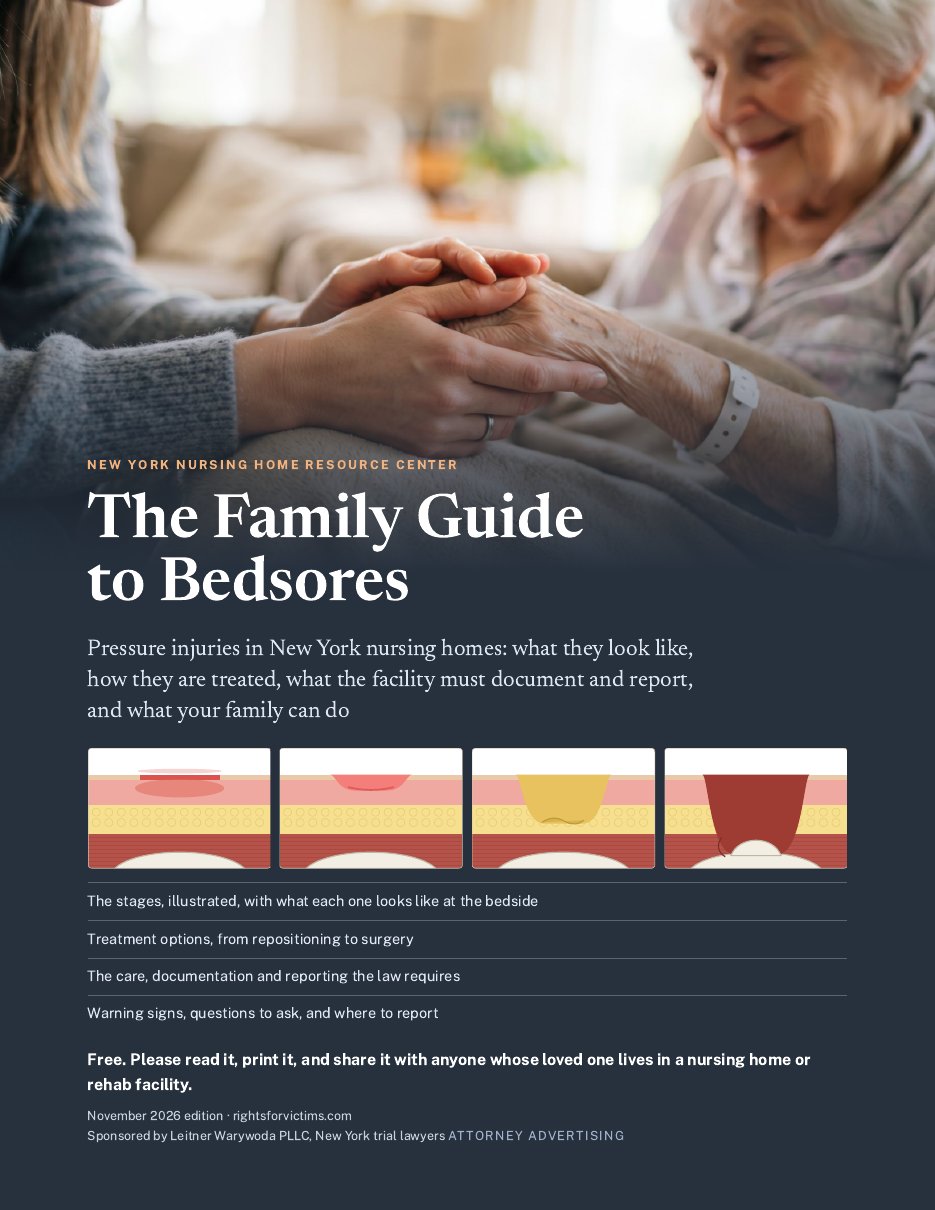
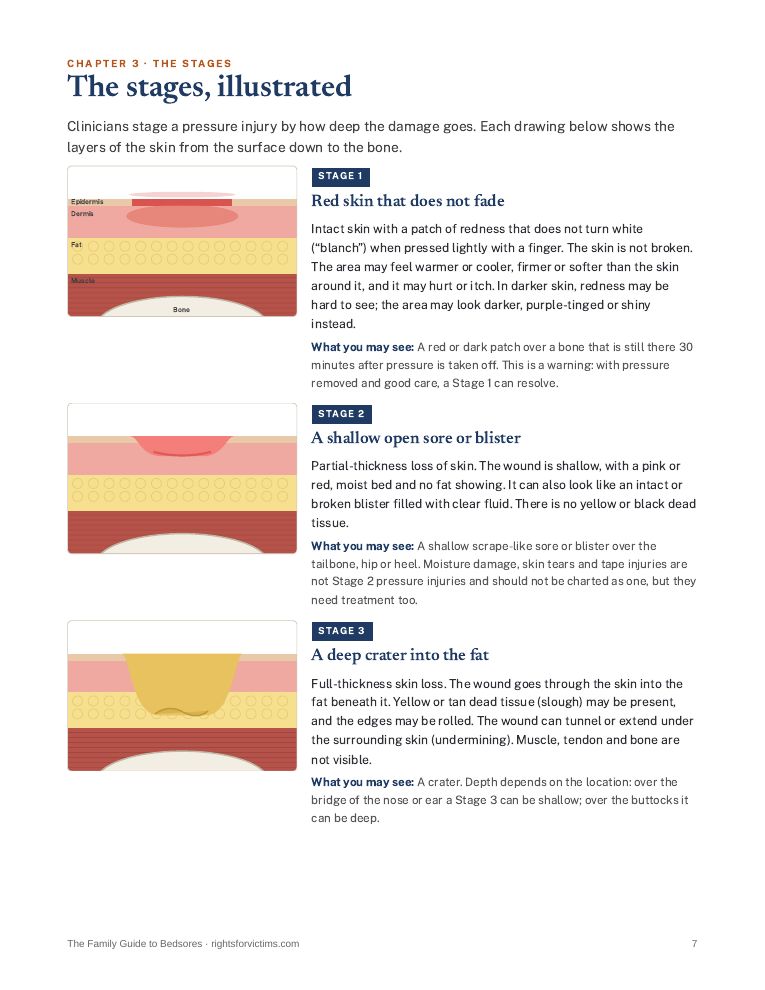
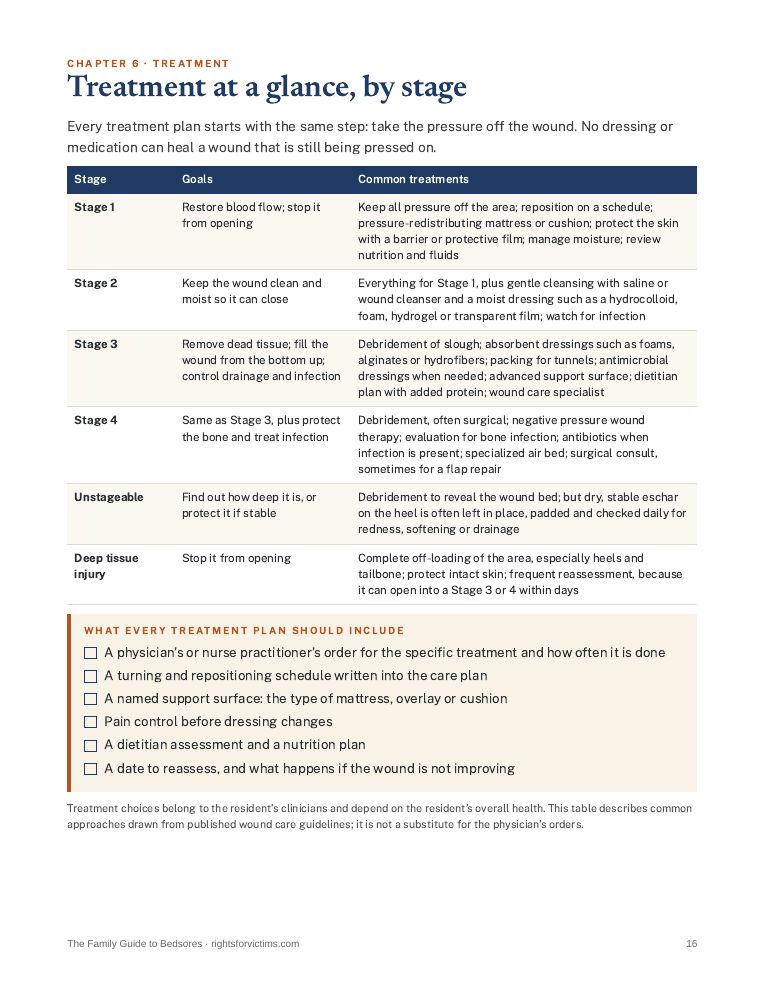
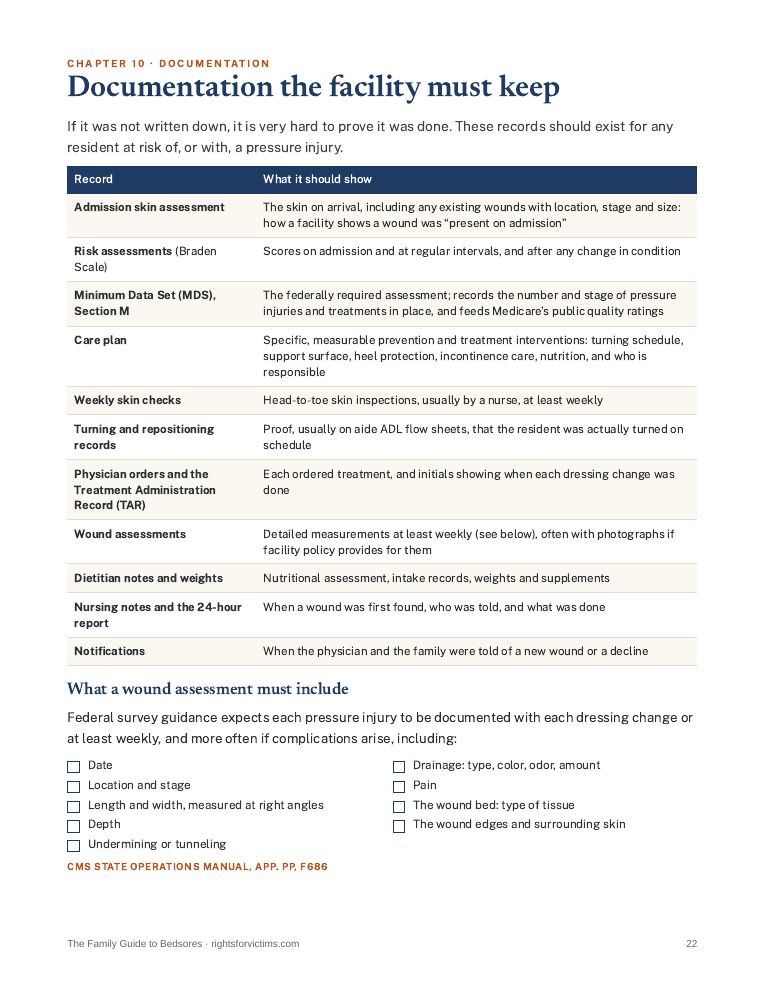
The Family Guide to Bedsores
What pressure injuries look like at every stage, how they are treated, what a New York nursing home must document and report, and what your family can do. Illustrated, with photographs, a printable visit log and a glossary.
- Every stage illustrated, from red skin to exposed bone
- Treatment options, from repositioning to surgery
- The documentation and reporting the law requires
- Warning signs, questions to ask and how to get the records
- Where to report, and the deadlines that protect your rights
PDF · 2 MB · No sign-up · Prints on any home printer · Also available from the New York Nursing Home Resource Center
Queens cases: court, deadlines and reporting
Cases from Flushing and Northeast Queens are filed in Supreme Court, Queens County, 88-11 Sutphin Boulevard, Jamaica. When a resident has died, the estate is opened in the Surrogate’s Court at 88-11 Sutphin Boulevard, Jamaica; only the appointed administrator or executor can bring the wrongful death and survival claims, and we handle the limited letters of administration as part of the case.
Our New York City office is at 14 Penn Plaza, Suite 1718. We meet families at home, at the bedside or at the office.
- Public Health Law § 2801-d and negligence claims: generally three years from the injury (CPLR 214).
- Claims framed as medical malpractice: generally two years and six months (CPLR 214-a).
- Wrongful death: two years from the date of death (EPTL 5-4.1).
To report a problem: call 911 in an emergency; file a complaint with the New York State Department of Health, Centralized Complaint Intake, 1-888-201-4563; and contact the New York State Long Term Care Ombudsman Program (ltcombudsman.ny.gov).
Nearby areas we serve
Serving Flushing and Northeast Queens
Bayside · College Point · Douglaston · Flushing · Fresh Meadows · Glen Oaks · Little Neck · Murray Hill · Whitestone
Questions families ask
My parent is in a nursing home in Flushing and Northeast Queens and has a bedsore. What should I do first?
Photograph the wound if you can do so respectfully, write down the date and what staff told you, and ask the home in writing for the care plan and the wound records. Then call us. If the wound is getting worse, ask for the physician and wound team the same day.
Can we bring a claim while our family member still lives there?
Yes. Retaliation against a resident for a complaint or lawsuit is prohibited, and many families bring claims while their parent remains in the home, or after moving them.
How long do we have?
Generally three years for Public Health Law § 2801-d and negligence claims, two and a half years for medical malpractice claims and two years for wrongful death. Public facilities can require a notice of claim within 90 days. The facts can change these periods, so call early.
What does it cost?
Nothing up front. We work on a contingency fee, which means no fee unless we recover.
Attorney Advertising. This page provides general information, not legal advice for any specific situation. Facility and crash data are reproduced from public CMS and New York State sources as of the dates shown and are not a statement by the firm about any facility’s care of any particular resident. Prior results do not guarantee a similar outcome.